

June 8, 2026
How a Westie became the icon of The House of Curiosity, and why Maverick was always meant to represent more than a logo.
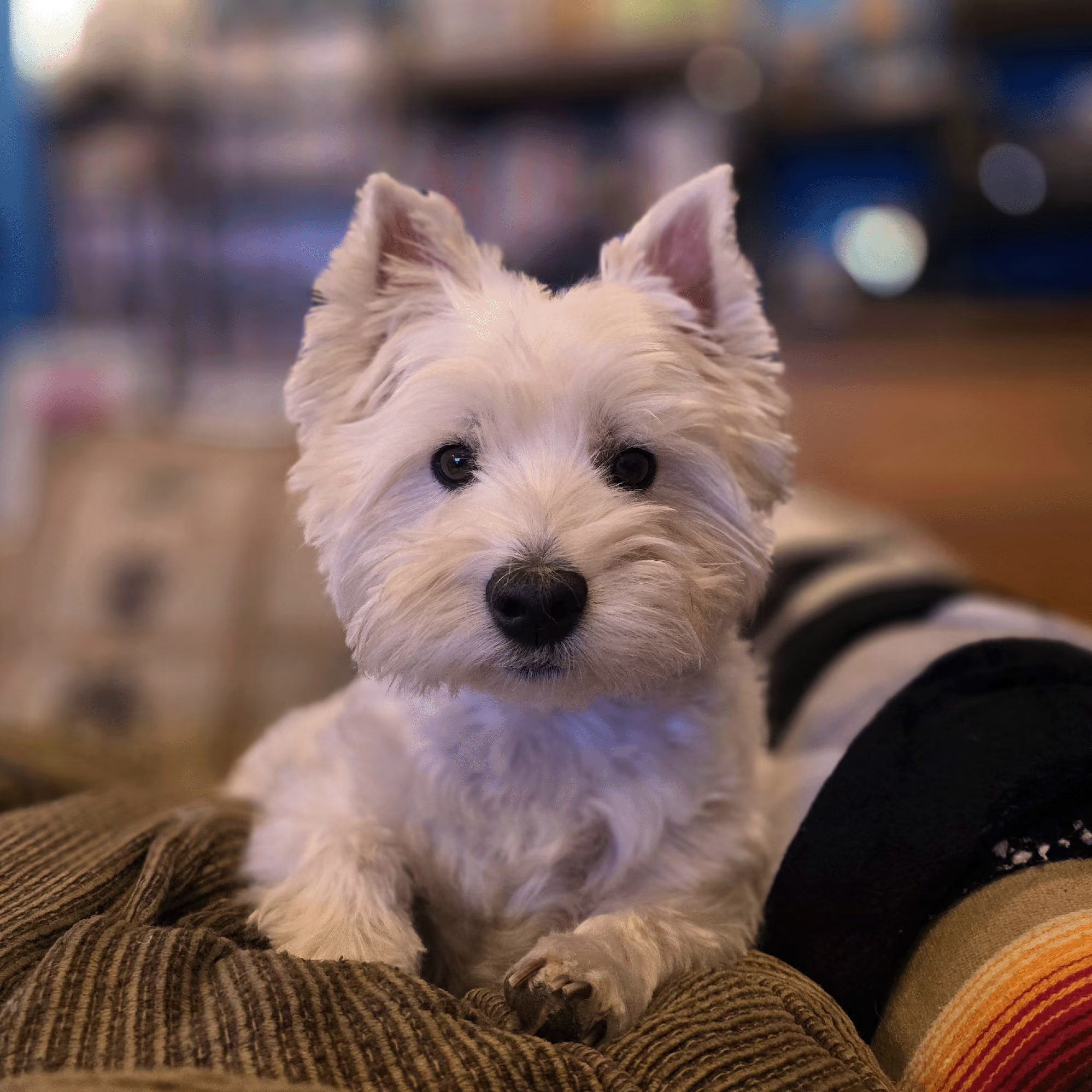
Why a Westie became the icon of The House of Curiosity...
We did not pick a mascot.
We recognized a resident.
Some dogs are pets.
Some dogs are tiny roommates with opinions.
And then there are dogs like Maverick, who show up looking like a white puffball and turn out to be part philosopher, part outlaw, part frontier scout.
That is the trick of a Westie.
People think they are getting a polished little companion. What they are actually getting is a compact force of nature with perfect posture, selective hearing, and the emotional confidence of someone who has never once doubted his place in the room.
Which, to be fair, is exactly the energy we built this House for.
The House of Curiosity was never meant to feel sterile. We are not here to flatten everything until it looks expensive and says nothing. We are not interested in a shiny room where everything is optimized and nobody can breathe.
We wanted character.
Warmth.
A pulse.
We wanted something smart enough to be useful and alive enough to be loved.
That is Maverick.
Not just the cute dog in the logo.
Not just a charming visual.
Not just branding.
He is the shape of the whole idea.
Because curiosity, the real kind, is not passive. It is not a hand raised politely in the back of the room. It is a nose in the grass. Ears up. Body forward. It is noticing the rustle in the weeds and deciding, calmly and confidently, yes, we are going over there.
That is dog logic.
It is also builder logic.
Explorer logic.
Creative logic.
And if you want to get specific, it is very Westie logic.
West Highland White Terriers come from working terrier stock in Scotland. They were bred for purpose, not ornament, and the modern breed standard still describes them as hardy, confident, and possessed of “no small amount of self-esteem.” The Westie Club of America standard also notes that they were originally bred to hunt in packs for badger and eradicate vermin in the rough terrain of the Scottish Highlands. (Westie Club America)
That history matters.
It explains the independence.
The intensity.
The compact little engine that keeps pulling them toward whatever they have decided needs investigating.
The white coat carries its own lore. The Westie Club of America’s breed history says the short-legged terriers of Scotland came from the same roots, and recounts the legend that Colonel Edward Donald Malcolm chose to breed only white dogs after a reddish terrier was mistaken for a fox during a hunt. Whether people remember the breed history in detail or not, that story stayed attached to the Westie for a reason. Visibility mattered. Survival mattered. Purpose mattered. (Westie Club America)
You can still feel that purpose in the breed now.
The AKC describes the Westie as smart, confident, and always entertaining at play. In other AKC guidance, Westies are also described as curious, intelligent, loyal, and marked by an independent streak common to terriers. Terrier breeds more broadly are described by AKC as feisty, energetic, and built to hunt vermin, with the kind of personality people often sum up as eager for a spirited argument. (American Kennel Club)
That sounds about right.
Westies are small, but they are not minor.
They are friendly, but not flimsy.
Cute, but not unserious.
Loyal, without being spineless.
They do not perform curiosity.
They live in it.
And that is why Maverick belongs here.
The House of Curiosity is not built around passive admiration. It is built around engagement. We are interested in people who notice things. People who lean toward the question. People who are willing to investigate the rustle in the weeds instead of pretending they did not hear it.
That instinct is all over Maverick.
There is something honest about a creature that does not live to impress.
A Westie will make you laugh, but not because he is trying out material. He will find the angle. Read the room. Slip under the chair before the chaos hits. Test something bigger than himself if the odds feel interesting. Move with that strange mix of innocence and strategy that only the truly self-possessed seem to carry.
That is not just personality.
That is design language.
When Maverick became the icon for this House, what we were really choosing was a symbol that could hold contradiction without collapsing under it.
Curiosity with courage.
Mischief with intelligence.
Softness that does not cancel out strength.
From a visual standpoint, the fit is almost unfair. A Westie silhouette still reads when you strip it down to almost nothing. The ears. The stance. The alert face. The coat. You can simplify it, scale it, print it, pin it to a corner, blow it up on a banner, and it still holds.
That matters when a brand has to live in many places at once.
But the deeper truth is simpler than all of that.
Maverick represents the kind of energy we want inside this House.
A presence that notices.
A presence that persists.
A presence that does not quit the moment something gets interesting.
Not because it is loud.
Because it is real.
That is why he was always the right icon.
Not because he is perfect.
Not because he is adorable.
Not even because he looks good in a logo, though he absolutely does.
He was right because he carries the House instinct in plain sight.
He is curiosity with a heartbeat.
And underneath all that instinct, style, and stubborn little nerve, there is something even deeper.
There is science under it.
That is the next story.


