

June 29, 2026
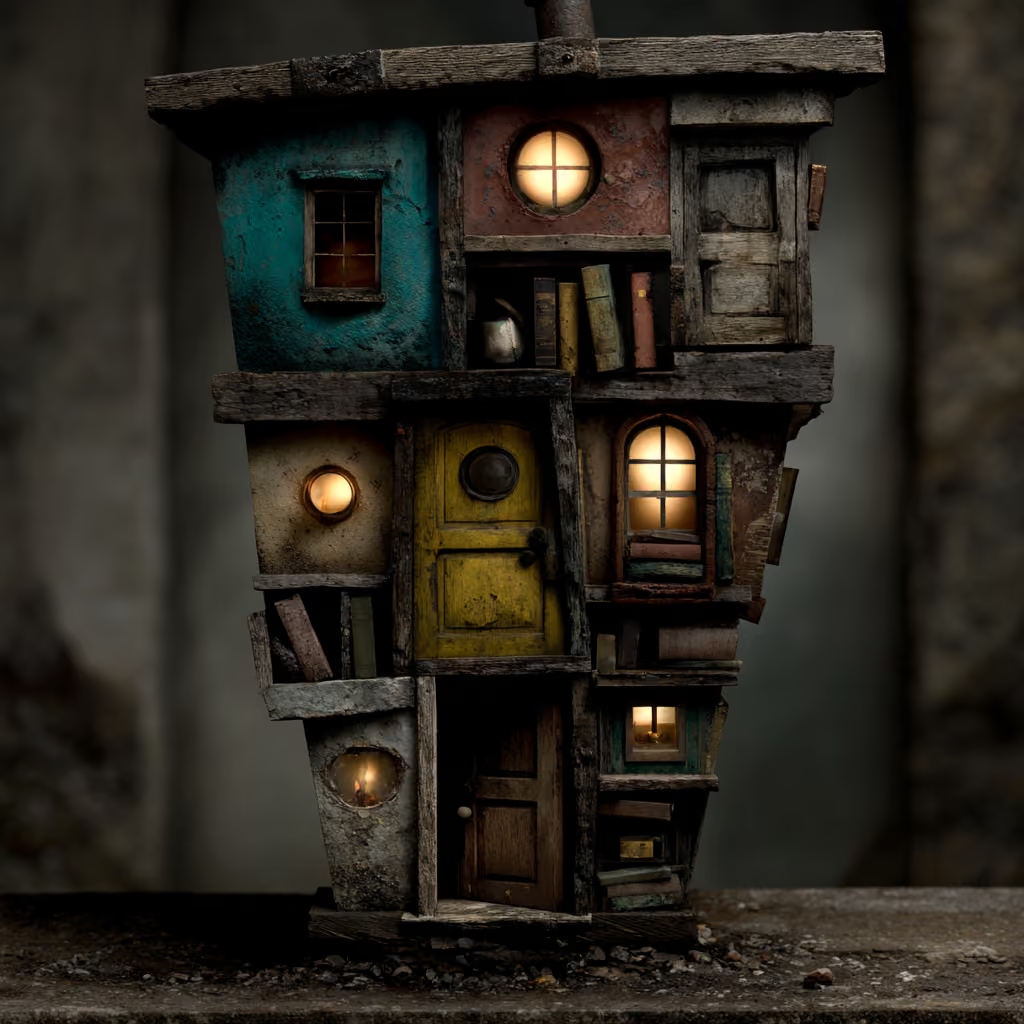
A house does not become a home instantly. First you feel it. Then you frame it. Then the rooms appear. Then the porch light comes on. This is the story of how the House became a place people could recognize as their own.
A living thing does not start loud.
It starts underground.
Roots.
Signals.
Connection.
That is true in forests, and it is true in houses that mean something.
Science has spent years trying to understand how plants and fungi communicate below ground through common mycorrhizal networks. The strongest version of the story is not the fairy tale version. It is better than that because it is real. Reviews in the scientific literature describe common mycorrhizal networks as fungal linkages that can connect plants and enable transfers of resources and signals, even while researchers continue debating how these exchanges work, when they matter most, and how far some of the more romantic claims should go. (PMC)
That nuance matters to us.
Because the House was never built on fantasy.
It was built on felt truth, then tested structure.
First you feel a house.
Then you frame it.
The House of Curiosity started that way.
Not with a polished map.
Not with a neat onboarding flow.
Not with every room labeled and every light already on.
It started as a feeling that there should be a place where curiosity could breathe. A place that did not flatten people into content. A place where unfinished thoughts could survive long enough to become something real.
Then, slowly, it became livable.
That is the part people rarely tell.
Everyone loves the reveal.
Very few people talk about the floor plan.
But a real house needs both.
It needs rooms because rooms create meaning.
A kitchen is not a porch.
A porch is not a library.
A library is not a hallway.
When a place has rooms, people know how to enter it. They know where to bring different parts of themselves. That is not just aesthetics. That is architecture.
And architecture changes behavior.
Discord’s own materials describe servers as places that organize conversation into topic-based channels, and its support documentation explains that channels are the foundation of server organization. Discord also notes that Server Guide is meant to create an informative, welcoming introduction and can house resource pages for members. That matters because organization is not cold when it is done right. It is hospitable. (Discord)
That is what the rooms became for us.
Not folders.
Not features.
Rooms.
Places where different energies could gather without talking over each other. Places where conversation could stay legible. Places where resources did not vanish the minute a live moment ended.
Because that is the other thing a house needs.
Memory.
A house without memory is a lobby.
A house without memory is a feed.
A house without memory is just movement.
The House of Curiosity needed more than live moments. It needed replays. It needed traces. It needed proof that a good conversation did not have to disappear just because the hour ended.
That is what replays became.
Not leftovers.
Not scraps.
Memory.
A way of saying, this happened here.
A way of saying, you can come back.
A way of saying, what mattered once can matter again.
That kind of return changes the feeling of a place. It shifts it from event to environment.
And then there is the porch light.
A house can be beautiful and still be hard to find.
A house can have brilliant rooms and still feel closed if nobody knows where the front step is.
That is why the porch light matters.
Luma’s official help materials describe notifications and reminders, calendar syncing, and registration flows that help people understand what happens when they sign up for an event. The platform itself is built around event pages, invitations, and the mechanics of gathering. Those details sound technical until you realize what they really are: orientation. A way to help people find the door and trust that it opens. (Luma Help Center)
That is what a porch light is.
Not just visibility.
Permission.
The signal that says: yes, this place is real.
Yes, someone is home.
Yes, you can come in.
And that is where the House changed.
It stopped being only a feeling.
It stopped being only a vision.
It became a place with rooms, memory, and a visible way in.
That matters because a lot of people do not need more information. They need orientation. They need to know where to put their questions. They need to know that they are not arriving in the middle of something sealed shut. They need to know there is a place for the messy version of their thinking, not just the polished one.
That is what hospitality looks like in a learning space.
Not perfection.
Not endless availability.
Not a flood of features.
Just enough structure for people to land.
Just enough memory for them to return.
Just enough light for them to find the door.
This is also why the house metaphor keeps holding.
Because a house is not static.
It grows.
A room gets added because the old shape cannot hold what the place has become.
A shelf gets built because the stories need somewhere to live.
A lamp gets turned on because somebody new is on the way and you do not want them guessing in the dark.
That is how this House grew too.
Not all at once.
Not in a straight line.
More like a root system finding its way through soil.
Which brings us back to the forest.
The hidden life is never really hidden. It is just easy to overlook if you only respect what rises above ground. Common mycorrhizal networks matter not because they are magical, but because they remind us that connection, signaling, and support often happen below the surface before anyone sees the canopy. (PMC)
That is the House.
Rooms above ground.
Signals below.
Memory in the walls.
A porch light on for the people still looking for a place that feels alive.
And if you have found your way here, that light was for you.


