

June 22, 2026
Play is not fluff, nostalgia, or a childish leftover. It is one of the oldest ways human beings learn, regulate, experiment, and make meaning. This is why the House still makes room for play.
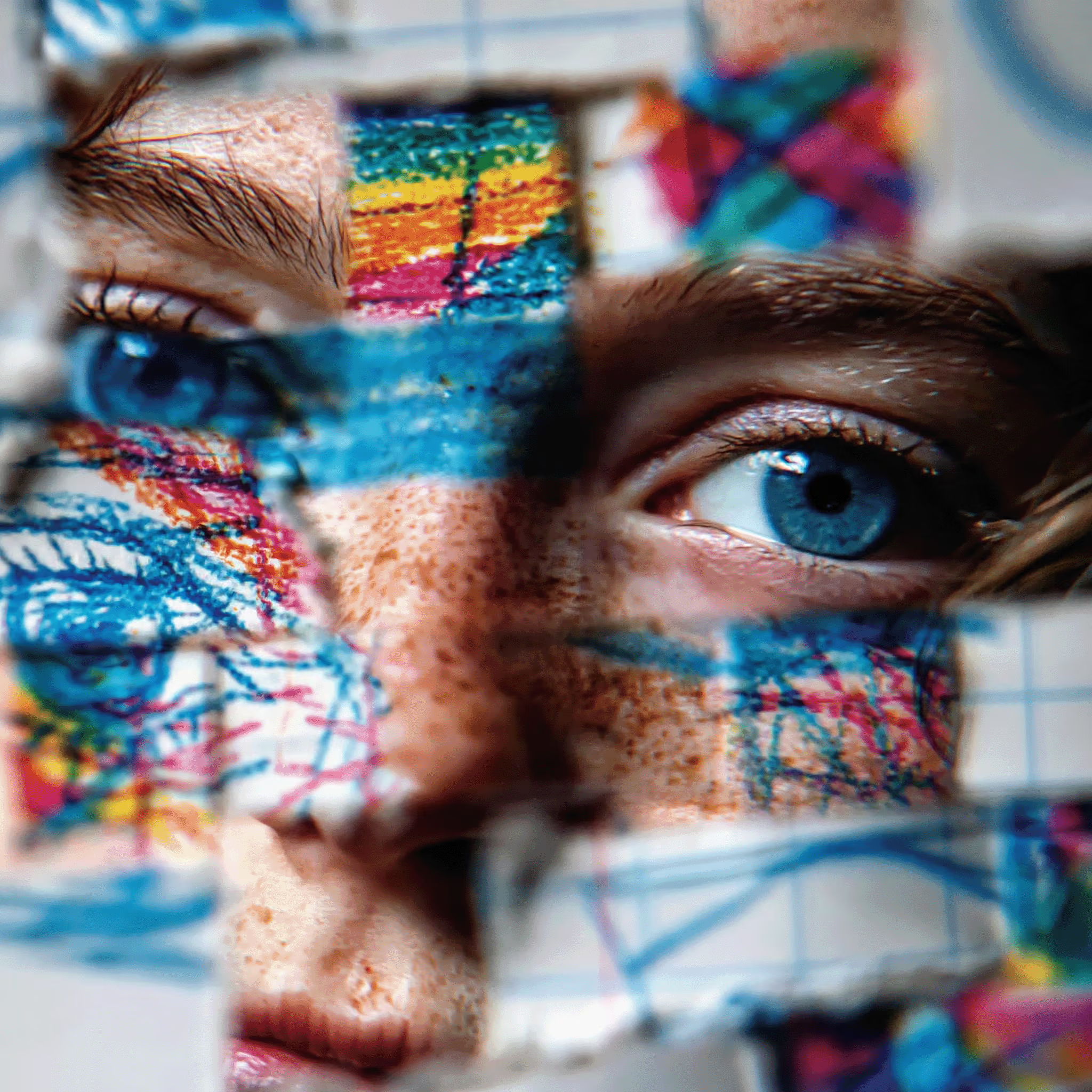
There is a kind of ache that does not look like nostalgia until you sit with it long enough.
Not nostalgia for a toy.
Not nostalgia for a decade.
Nostalgia for a learning mode.
A lot of people remember boredom turning into invention. Wandering. Making things up. Learning without needing to justify it first. That is not romantic nonsense. The American Academy of Pediatrics treats play as part of healthy development, not a bonus feature, and research on children’s time use has tracked declines in discretionary time alongside shifts toward more structured activities. (Maryland AAP)
That is part of why this House feels the way it feels.
The House of Curiosity was never built for people who want to sit still and be told what to think. It was built for people who want to test an idea, chase a thread, say the unfinished thing out loud, and see what happens next. It was built for the people who still remember, or still crave, the feeling of learning because they are pulled forward, not dragged.
Boomers know this language.
Gen X knows it too.
A lot of millennials feel it like a bruise.
That last part is an observation, not a lab result. But it is grounded in a real shift. Research suggests many children’s days became more scheduled and less discretionary over time, especially across the late twentieth century and early 2000s. That helps explain why many millennials feel like a hinge generation. Old enough to remember more wandering, young enough to feel the full arrival of optimization as the background music. (PMC)
And younger generations are not late to the story.
They inherited a more measured environment.
More managed time.
More screens.
More supervision.
More pressure to be legible early.
That does not make them less capable of playful learning. It means they were handed less of it by default. Research does document changes in children’s daily lives that line up with that feeling, including declines in discretionary time and shifts in how time gets spent. (PMC)
This matters because play is not fluff.
The American Academy of Pediatrics says play enhances brain structure and function and promotes executive function, meaning the process of learning itself, not just the content. The same report ties play to social-emotional skills, language, self-regulation, and the relationships children need to thrive. (Maryland AAP)
That is a big deal.
Because what a lot of people miss when they talk about play is that they are really talking about agency.
The ability to decide what to do next.
The ability to follow a hunch.
The ability to notice, test, revise, and try again.
There is research behind that, too. In a 2014 study, Barker and colleagues found that children who spent more time in less structured activities showed better self-directed executive functioning, while more time in structured activities predicted poorer self-directed executive functioning. (PubMed)
That finding should make more people sit up.
Because it suggests that when people have room to steer themselves, something important gets practiced. Not just compliance. Not just performance. Self-direction.
And self-direction matters to this House.
The House is not interested in turning adults back into children. It is interested in restoring a learning posture many adults were trained out of.
Somewhere along the way, a lot of people stopped experimenting in public.
Stopped following the rustle in the weeds.
Stopped asking a question unless they were already half sure of the answer.
Stopped trusting play unless it could prove itself as productivity.
That is a loss.
Not just emotionally.
Cognitively.
Curiosity research helps explain why. A major review in Neuron describes curiosity as a basic element of cognition, influential in learning and decision-making, and crucial for healthy development. One of the foundational accounts of curiosity, Loewenstein’s information-gap theory, argues that curiosity arises when attention becomes focused on a gap in knowledge. (PubMed)
That means play and curiosity are not strangers.
Play is one of the oldest environments where curiosity gets to move naturally. It gives people room to notice, improvise, test, fail, adjust, and stay with a question long enough for it to become meaningful. And when curiosity becomes meaningful, memory changes. Research has linked curiosity to reward circuitry and better memory for both target information and nearby incidental information. (PubMed)
So when we talk about the lost language of play, we are not talking about cuteness.
We are talking about a mode of learning.
We are talking about the difference between being managed and being awake.
The difference between consuming and discovering.
The difference between being told and leaning in.
This is also why the House refuses to confuse seriousness with stiffness.
A serious room is not the same thing as a dead room.
A smart room is not the same thing as a fearful room.
A useful room is not the same thing as a joyless one.
The House makes room for play because play is one of the oldest serious things we know.
It is where people rehearse freedom.
It is where they practice noticing.
It is where they learn to build meaning from fragments.
Peter Gray argued that children’s free play declined sharply over the past half century and connected that decline to broader shifts in young people’s well-being. That is his argument, not a settled universal verdict, but it names a pattern a lot of people can feel. (ERIC)
The House is interested in that feeling, and in what comes after it.
Not sentimentality.
Restoration.
Not pretending the modern world is going away.
Learning how to stay human inside it.
That is what we mean when we say the House is for everyone who learned through play, and for everyone trying to get that learning mode back.
Boomers are part of that story.
Gen X is part of that story.
Millennials are part of that story.
So are the people who grew up in a more optimized world and still deserve a place where curiosity has room to breathe.
That language is not gone.
It is just underused.
This House is here to speak it again.


