

June 1, 2026
Three co-founders. Three instincts. One shared fire. Welcome to The House of Curiosity, a place built from structure, edge, and steady power, where curiosity is more than a feeling.
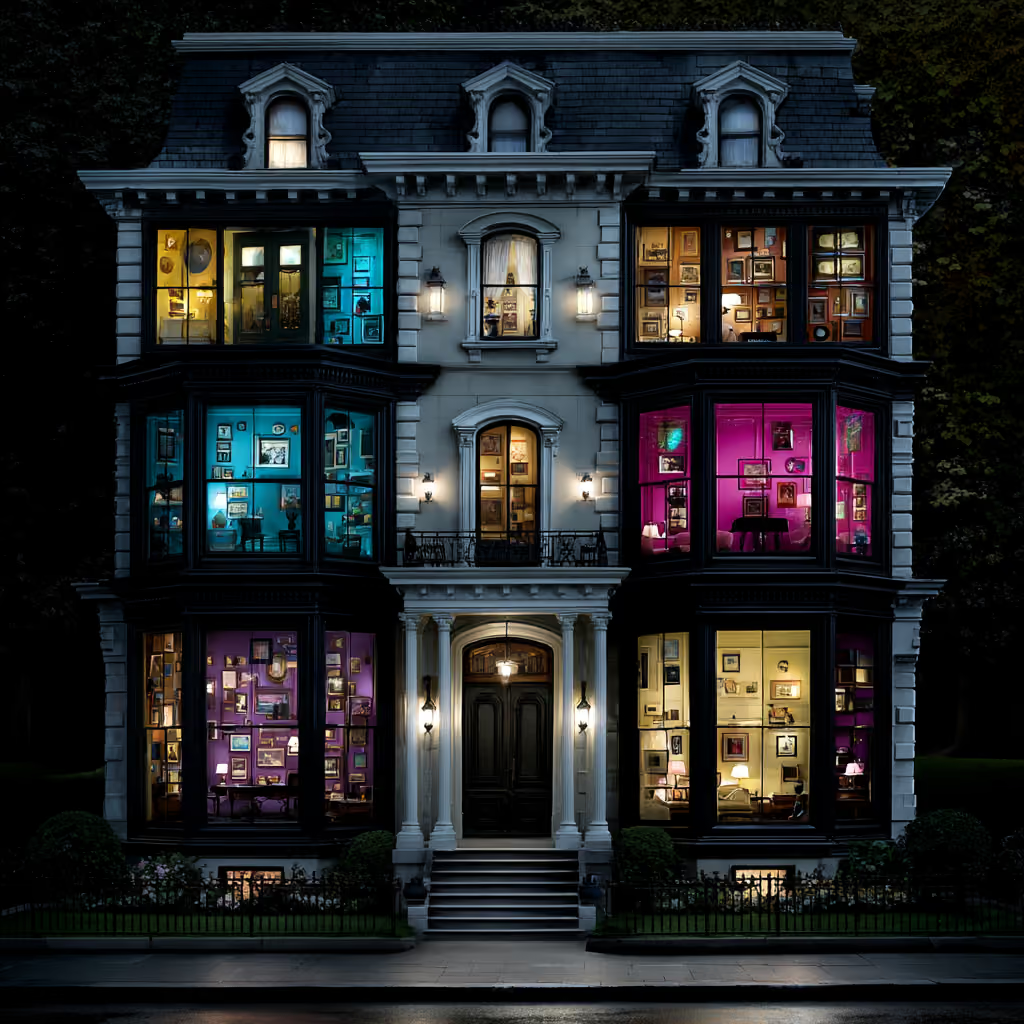
The first version of this was not a brand.
It was a conversation. Late enough to be honest. The kind of conversation that happens when something in you is restless and you finally stop pretending you cannot feel it.
Not more information.
Not more tools.
Not more polished noise dressed up as insight.
What was missing was a place where learning still felt alive.
A place where people could try things.
A place where unfinished thoughts were allowed in the room.
A place where a better question mattered more than a perfect answer.
That place became The House of Curiosity.
It had another name at first. The Curiosity Co-op. Then the name had to change, and somehow the new name fit even better. A co-op is a project. A house is a world.
And this one began with three co-founders:
Karissa. Laurie. Israel.
Three different instincts.
Three different kinds of force.
Three different ways of seeing the same missing piece.
That is why the three-headed dragon matters.
Not because it sounds cool.
Because it tells the truth.
We call ourselves the three-headed dragon because we recognized ourselves in a pattern that already existed in culture. There is an old resurfaced clip where 50 Cent describes the trio with Dr. Dre and Eminem as a “three headed monster,” and what makes the phrase stick is not celebrity. It is chemistry. Distinct roles. Shared direction. Clear force. (HotNewHipHop)
A trio works when each force protects the others from becoming too much of themselves.
One part of the House hears structure first.
Architecture. Rhythm. Sequence. The instinct to take chaos and turn it into something people can actually live inside.
One part hears the image first.
The edge. The emotional hit. The frame that lands like truth and refuses to flatten into something generic.
One part brings steady power.
Calm force. The kind that makes the room feel safe, then makes the idea real.
That is the dragon.
Not three people doing the same thing.
Three people doing three different things in the same direction.
Blueprint.
Voice.
Engine.
That was the founding shape of this House.
And it turns out, that shape does not just feel right artistically. It mirrors the thing the House was built around in the first place: curiosity.
Because curiosity is not a cute trait. It is not a sprinkle of personality on top of intelligence. One of the foundational explanations in curiosity research is George Loewenstein’s information-gap theory, which argues that curiosity appears when we become aware of a gap between what we know and what we want to know. That gap creates a kind of tension, and attention leans toward it. The brain wants the missing piece. (Carnegie Mellon University)
That matters more than it sounds like it does.
Because when curiosity becomes active, learning changes.
In a widely cited 2009 study, researchers found that epistemic curiosity was associated with activation in reward-related brain circuitry and with better memory for the answers people wanted to learn. In plain English, curiosity helps the brain treat learning like something worth pursuing, not something being forced on it. (PubMed)
Then the story got even better.
A 2014 study found that when people were in high-curiosity states, they remembered not only the information they were curious about, but also incidental information they encountered nearby. Curiosity did not just sharpen memory for the target. It widened what stuck. (PubMed)
That is the Curiosity Effect.
Not a slogan.
Not a branding trick.
A mechanism.
Curiosity increases attention.
Curiosity supports persistence.
Curiosity strengthens memory. (PubMed)
A major review in Neuron put it plainly: curiosity is central to learning and decision-making, even if researchers still argue about the cleanest way to define and measure it. That does not weaken the idea. It makes it more human. We know curiosity matters before we can always pin it down neatly. (PMC)
That is where The House begins to make sense as more than a name.
The House of Curiosity was built by Karissa, Laurie, and Israel, three co-founders with different gifts, but it was built around one real conviction: if you create the right conditions, people learn differently. Better. Deeper. With more ownership. With more life in it.
That is why this was never meant to be another community.
That word got cheap somewhere along the way.
Too many rooms with no memory.
Too many feeds pretending to be homes.
Too many spaces where people were expected to perform intelligence instead of practice it.
A house is different.
A house remembers.
A house holds shape.
A house lets people arrive unfinished and still expects them to grow.
That was the instinct at the beginning.
Karissa could feel the structure before it was visible.
Israel could feel the image, the edge, the emotional hit that makes a thing memorable.
Laurie could feel the room, the trust, the steady force needed to make something real without crushing the people inside it.
None of those instincts would have been enough alone.
Together, they made the House possible.
That is also why the dragon still matters.
A dragon is not a mascot.
It is a living problem.
A force that only works if the heads know what the others are doing.
Too much structure and you get rigidity.
Too much edge and you get chaos with a great caption.
Too much force without art or architecture and you get movement with nowhere interesting to go.
But get the mix right and now you have a body.
Now you have motion.
Now you have heat.
Now you have something people can gather around.
That is the story no one told cleanly enough before.
The House was not born as a content engine.
It was born as an instinct shared by three co-founders who each recognized a different missing piece.
One knew how to build the room.
One knew how to make it hit.
One knew how to make it hold.
And underneath all of it was a deeper truth the science helps name: people do not just need information. They need conditions that make information come alive. They need a question worth following. They need enough safety to explore, enough spark to care, and enough structure to come back. (Carnegie Mellon University)
That is what curiosity does to the brain.
And that is what the House is trying to do in practice.
Not fill people with content until they go numb.
Not flatten learning into productivity theater.
Not reduce building to a performance.
We are trying to create a place where curiosity can do what it has always done at its best.
Pull attention forward.
Wake up memory.
Make people feel more alive while they learn. (PubMed)
That is The House of Curiosity.
A house built by Karissa, Laurie, and Israel.
A house ruled by a three headed dragon.
Welcome home.


